<?xml version="1.0" encoding="UTF-8"?>
<rss version="2.0"
	xmlns:content="http://purl.org/rss/1.0/modules/content/"
	xmlns:wfw="http://wellformedweb.org/CommentAPI/"
	xmlns:dc="http://purl.org/dc/elements/1.1/"
	xmlns:atom="http://www.w3.org/2005/Atom"
	xmlns:sy="http://purl.org/rss/1.0/modules/syndication/"
	xmlns:slash="http://purl.org/rss/1.0/modules/slash/"
	>

<channel>
	<title>libia-olafur.com</title>
	<atom:link href="http://libia-olafur.com/?feed=rss2" rel="self" type="application/rss+xml" />
	<link>http://libia-olafur.com</link>
	<description>Just another WordPress weblog</description>
	<lastBuildDate>Wed, 21 Oct 2009 13:06:13 +0000</lastBuildDate>
	<generator>http://wordpress.org/?v=2.8</generator>
	<language>en</language>
	<sy:updatePeriod>hourly</sy:updatePeriod>
	<sy:updateFrequency>1</sy:updateFrequency>
			<item>
		<title>SPAPORT BIENNIAL 2009/2010, Banja Luka, Bosnia-Herzegovina – 20.10 – 15.11.2009</title>
		<link>http://libia-olafur.com/?p=636</link>
		<comments>http://libia-olafur.com/?p=636#comments</comments>
		<pubDate>Wed, 21 Oct 2009 09:41:40 +0000</pubDate>
		<dc:creator>OO</dc:creator>
				<category><![CDATA[2009]]></category>
		<category><![CDATA[works]]></category>

		<guid isPermaLink="false">http://libia-olafur.com/?p=636</guid>
		<description><![CDATA[Where Everything Is Yet to Happen
1st chapter: &#8220;Can you speak of this? -Yes, I can&#8221;
Curated by Ivana Bago &#38; Antonia Majača
@ Institute for Duration, Location and Variables (DeLVe)
www.delve.hr
Co-curators of the ‘1st chapter’ exhibition:
Anselm Franke, Vít Havránek &#38; Zbyněk Baladrán, Ana Janevski, Erden Kosova, Nina Möntmann, Jelena Vesić
Participating artists and projects:
Ziad Antar, Yane Calovski, Libia Castro [...]]]></description>
			<content:encoded><![CDATA[<div id="attachment_640" class="wp-caption alignnone" style="width: 510px"><img class="size-full wp-image-640" title="02_Tznp" src="http://libia-olafur.com/images/02_Tznp1.jpg" alt="Tvoja zemlja ne postoji / Your country doesn´t exist" width="500" height="341" /><p class="wp-caption-text">Tvoja zemlja ne postoji / Your country doesn´t exist - Billboards in public space</p></div>
<p><strong>Where Everything Is Yet to Happen<br />
1st chapter: &#8220;Can you speak of this? -Yes, I can&#8221;</strong></p>
<p>Curated by Ivana Bago &amp; Antonia Majača<br />
@ Institute for Duration, Location and Variables (DeLVe)<br />
www.delve.hr</p>
<p>Co-curators of the ‘1st chapter’ exhibition:<br />
Anselm Franke, Vít Havránek &amp; Zbyněk Baladrán, Ana Janevski, Erden Kosova, Nina Möntmann, Jelena Vesić</p>
<p>Participating artists and projects:<br />
Ziad Antar, Yane Calovski, Libia Castro &amp; Ólafur Ólafsson, Ivan Grubanov, Nicoline van Harskamp (in collaboration with Thijs Gadiot), Dragan Nikolić, Slaven Tolj, Liu Wei, Judi Werthein (Ivana Bago &amp; Antonia Majača, “Can you speak of this? –Yes, I can.”)<br />
Florian Schneider, Eyal Weizman (Anselm Franke, Circles of Collaboration)<br />
The Archive of Self-Management (Vít Havránek &amp; Zbyněk Baladrán)<br />
Yael Bartana, Danilo Kiš, Artur Żmijewski, Želimir Žilnik (Ana Janevski, If You Want, We’ll Travel to the Moon Together)<br />
A.C.A.B., Ronen Eidelman, Aydan Murtezaoğlu (Erden Kosova, Stepping Sideways)<br />
Yael Bartana, Esra Ersen, Sharif Waked (Nina Möntmann, We Hear You Speaking in Secret Dialects)<br />
Lutz Becker, Chto Delat/What is to be done? (Jelena Vesić, The Future Is the Extension of the Past by Other Means)</p>
<p><span id="more-636"></span><img class="alignnone size-full wp-image-643" title="01_Tznp" src="http://libia-olafur.com/images/01_Tznp.jpg" alt="01_Tznp" width="500" height="342" /><br />
Tvoja zemlja ne postoji / Your country doesn´t exist &#8211; Billboards in public space<br />
<img class="alignnone size-full wp-image-644" title="03_Tznp" src="http://libia-olafur.com/images/03_Tznp.jpg" alt="03_Tznp" width="500" height="342" /><br />
Tvoja zemlja ne postoji / Your country doesn´t exist &#8211; Billboards in public space</p>
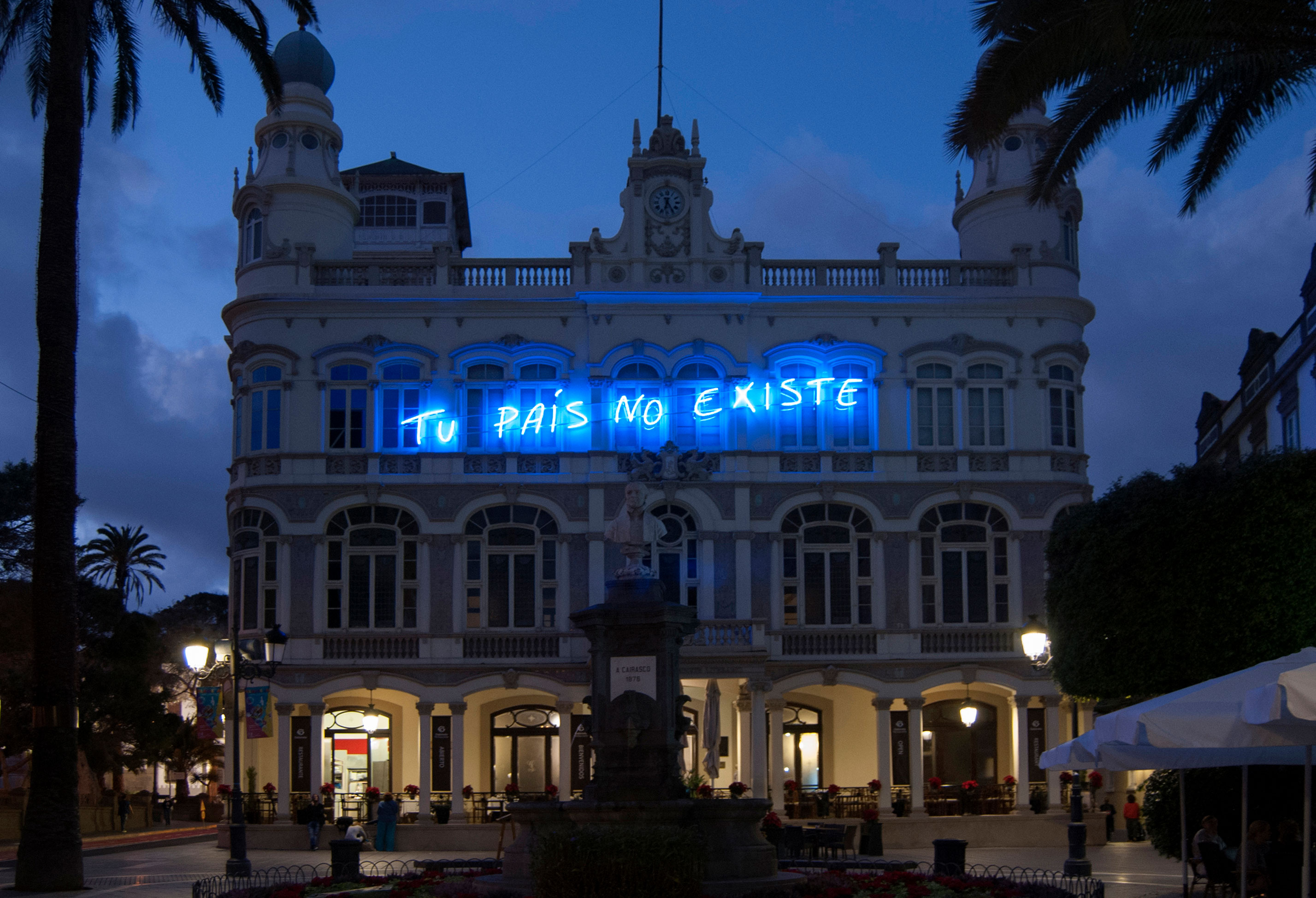
<p><em>Libia Castro &amp; Óafur Ólafsson, Your country doesn&#8217;t exist, 2003 &#8211; ongoing</em></p>
<p><em>Your country doesn’t exist is an ongoing campaign, appearing in different contexts, places, countries, and languages. So far it has appeared as a sculpture at Platform Garanti CAC; as an advertisement on national and regional TV and radio (in Iceland, the Netherlands and Austria); on billboards; as large painted wall drawings on houses and on a museum facade; in polyurethane foam and in clay; as a newspaper advertisement; as a postage stamp prototype in several museums; as a flyer; and as a drink automat serving cans of beer, soda, and water bearing the campaign’s slogan in different languages; on the cover of a magazine (a medical journal); as the coats of arms of two old sandstone  lyon sculptures guarding Museum Gouda (NL); as T-shirts and as a wall drawing in the Cafe of Rotor exhibition space in Linz etc. The work has traveled to Turkey, Iceland, Hungary, the Netherlands, Belgium, Austria and the United States &#8211; and now Bosnia and Herzegovina.</em></p>
<p>The title of the multi-faceted project Where Everything is Yet to Happen (WEIYTH) – starting off in Bosnia-Herzegovina in the framework of SpaPort Biennial 2009/10 – contains references to duration, location and variables of an expected event. These ‘uncertain parameters’ are located in a breach between a past that does not offer, in Badiou’s terms, an event to which we would bind ourselves to fidelity, and a future from which one expects precisely that &#8211; the “miracle” of event.</p>
<p>Although Bosnia-Herzegovina is the starting point of the project &#8211; with its perpetuating state of political &#8216;temporariness&#8217; resulting from the still unresolved ethnic tensions and war traumas, the lack of consensus on the basic geopolitical &#8216;constitution&#8217; and the unending protectorate of the &#8216;international community’ – it is by no means the only ‘place of expectation’. On the contrary, the project seeks to subvert the view of Bosnia-Herzegovina and the Balkans as the antithetical periphery of Europe, and refuses to exoticise it as a &#8217;space of conflict&#8217;. Rather, it establishes it as an originating point of the gaze for reflecting on the urgency to rethink the notions of future, community and co-existence beyond the dominant models of ethnopolitics and of the nation-state, both in ‘transitional’ as well as Western, ‘advanced’ neo-liberal democracies .</p>
<p>The 1st chapter of the project, the exhibition “Can you speak of this? -Yes, I can”, takes its cue from Agamben&#8217;s essay “On Potentiality&#8217; and his referece to Anna Akhmatova&#8217;s introduction to her poem Requiem, in which she recounts how, while waiting in line in front of the Leningrad jail during the Stalin purges, a woman suddenly asked her if she could „describe this“. To this request to articulate the horror that surrounded them, the poet answered affirmatively. As Agamben notes, “I can” here does not mean a conviction of the possession of certain capacities that guarantee success in ‘describing’ the indescribable, but a radical acceptance of the experience of potentiality – “[which] is, nevertheless, absolutely demanding”.</p>
<p>By appropriating the question and its explicitly affirmative answer, the first chapter of the project WEIYTH is a</p>
<p>way of setting up a stage for potentiality, one where „speech“, but also a refusal to speak can take place &#8211; first of all by asking the basic question of what art can, and must, speak about in complex political environments such as BH, specifically the Republic of Srpska, without taking a form of yet another &#8216;post/pre-emergency&#8217; biennial.</p>
<p>Answering this question emerges on the basis of curatorial &#8216;complicity&#8217; &#8211; by the involvement of a group of co-curators the initial starting points of the project were further articulated, accentuated or questioned, and new ones instigated, evolving into a polyphonic structure that opens up space for several points of departure for the future of the project which is itself in constant mode of becoming.</p>
<p>„Can you speak of this? -Yes I can“ is an elaboration of some of the themes and moments which have come into being gradually through the multidirectional communication among curators and artists, that reinforced its “diagnostic” and &#8221;analytic&#8221; capacity, forming the exhibition as an initial project thesaurus comprised of a series of topics and questions related to the issues of complicity, collaboration, politics of language, belonging, culturalization of politics, the potential of non-essentialist forms of community and finally, the audacity of speech as a form of the political.</p>
<p>The exhibition is accompanied by a publication with contributions by the artists, curators and co-curators.</p>
<p>Exhibition opening:<br />
Banja Luka Fortress, October 20, 2009, 8 pm</p>
<p>Roundtable discussion with Ivana Bago &amp; Antonia Majača, Vít Havránek, Ana Janevski, Anselm Franke and Jelena Vesić, October 20, 2009, 4 pm</p>
<p>Locations:<br />
Terzić Gallery | Salon of the Museum of Contemporary art | Banja Luka Fortress | Public space</p>
<p>WEIYTH is a project of the Institute for Duration, Location and Variables (DeLVe), conceived and developed by Ivana Bago &amp; Antonia Majača</p>
<p>Organized by:<br />
Protok – Center for Visual Communication<br />
Veselina Masleše 1/11, Banja Luka, BH<br />
www.protok.org</p>
<p>Supported by:</p>
<p>Swiss Cultural Program in the Western Balkans, Robert Bosch Stiftung, Ministry of Education and Culture of RS, City of Banja Luka, Ministry of civil affairs BH</p>
]]></content:encoded>
			<wfw:commentRss>http://libia-olafur.com/?feed=rss2&amp;p=636</wfw:commentRss>
		<slash:comments>0</slash:comments>
		</item>
		<item>
		<title>Prix de Rome &#8211; De Appel, Amsterdam and Witte de With, Rotterdam &#8211; 10.05 &#8211; 14.06.2009</title>
		<link>http://libia-olafur.com/?p=606</link>
		<comments>http://libia-olafur.com/?p=606#comments</comments>
		<pubDate>Wed, 15 Jul 2009 19:33:49 +0000</pubDate>
		<dc:creator>OO</dc:creator>
				<category><![CDATA[2009]]></category>
		<category><![CDATA[works]]></category>

		<guid isPermaLink="false">http://libia-olafur.com/?p=606</guid>
		<description><![CDATA[The PRIX DE ROME.NL is the oldest Dutch ‘state’ prize for talented visual artists based in the Netherlands and under 35 years of age.
The jury of the PRIX DE ROME.NL 2009 consists of Kestutis Kuizinas (LT), Yael Bartana (IL), Jurgen Bey (NL), Bruce McLean (UK) and Barbara Visser (NL). The jury has selected a long [...]]]></description>
			<content:encoded><![CDATA[<div id="attachment_607" class="wp-caption alignnone" style="width: 510px"><img class="size-full wp-image-607" title="LOBBIEIST08" src="http://libia-olafur.com/images/LOBBIEIST08.jpg" alt="Video still from Lobbyists" width="500" height="281" /><p class="wp-caption-text">Video still from Lobbyists</p></div>
<p>The PRIX DE ROME.NL is the oldest Dutch ‘state’ prize for talented visual artists based in the Netherlands and under 35 years of age.</p>
<p>The jury of the PRIX DE ROME.NL 2009 consists of Kestutis Kuizinas (LT), Yael Bartana (IL), Jurgen Bey (NL), Bruce McLean (UK) and Barbara Visser (NL). The jury has selected a long list of ten artists out of 230 submissions. This long list will be shown at both Witte de With in Rotterdam and by de Appel in Amsterdam at the off-site location of the Westergasfabriek (‘Zuiveringshal Oost’).</p>
<p>Witte de With presents work by: Rossella Biscotti (IT), Nicoline van Harskamp (NL), Rob Hornstra (NL), Helmut Smits (NL), and Jasmijn Visser (NL).<br />
De Appel shows (at the off-site location of the Westergasfabriek) work by: Maze de Boer (NL), Heidi Linck (NL), Ólafur Ólafsson i.c.w. Libia Castro, (IS / ES), Marc Oosting (NL), and Sara Rajaei (IR).</p>
<p>The PRIX DE ROME.NL 2009 exhibition has been curated by Sarah Farrar (de Appel) and Juan A. Gaitán (Witte de With).</p>
<p>The four finalists – Rossella Biscotti (I T), Nicoline van Harskamp (NL), Ólafur Ólafsson i.c.w. Libia Castro (IS / ES) and Sara Rajaei (IR) – made new work. On the basis of this work, the jury will grant the prizes of € 45.000, € 20.000, and the two awards of € 10.000.</p>
<p>Announcement on 28 May 2009 at the Westergasfabriek.</p>
<p><span id="more-606"></span></p>
<div id="attachment_649" class="wp-caption alignnone" style="width: 510px"><img class="alignnone size-full wp-image-653" title="LOBBIEIST02" src="http://libia-olafur.com/images/LOBBIEIST021.jpg" alt="LOBBIEIST02" width="500" height="281" /><br />
<p class="wp-caption-text">Video still, Lobbyists</p></div>
<p>TITLE: Lobbyists / YEAR: 2009 / A WORK BY:  Libia Castro &amp; Ólafur Ólafsson<br />
MATERIAL: Video HD, color, sound  / LENGTH: 16 mint<br />
LANGUAGE: Narration and vocals in English, spoken language; Dutch, English, Polish SUBTITLES: English and local language / MUSIC: Hjálmar / TEXT: Tamasin Cave<br />
NARRATION AND VOCALS: Caroline Dalton and Hjálmar / CAMERA: Libia Castro and Ólafur Ólafsson / EDITING: Kristján Loðmfjörð, Libia Castro and Ólafur Ólafsson<br />
APPEARENCE BY: Wytze Russchen &#8211; Russchen Consultants,<br />
Julie Vermooten &#8211; The European Cosmetics Association (Colipa),<br />
Frauke Thies &#8211; Green Peace, Paul de Klerck &#8211; Friends of the Earth Europe,<br />
Erik Wesselius &#8211; Corporate Europe Observatory (CEO) and others<br />
<em><br />
In this video, Castro and Ólafsson portray lobbyists performing under working conditions, exploring the maelstrom surrounding their activity in Brussels and Strasbourg. In preparation for their work, the artists studied historical and contemporary sources constructing the figure of the lobbyist, interviewed and filmed a variety of people associated with lobbyist associations and civilian ‘watchdog’ groups, and dug into registration and music videos. They commissioned British reporter Tamasin Cave to write an article about the current situation and worked with british actress Caroline Dalton and the Icelandic reggae group Hjálmar to perform this text as a new song and the soundtrack to their video. The video touches on different genres, juxtaposing imagery with a newspaper article vocalized to dub music, and throughout the work humor is used as a binding agent. These contrasting and sometimes alienating elements trigger the viewer´s active involvement and reflection on the subject of the work as well as on the work and medium itself.</em></p>
<p><strong>Lobbyists received third prize in the 2009 edition of the Dutch art prize Prix de Rome.</strong></p>
<p>This work has been made possible by the Rijksakademie van Beeldende Kunsten and Prix de Rome 2009, Amsterdam.</p>
<div id="attachment_656" class="wp-caption alignnone" style="width: 510px"><img class="size-full wp-image-656" title="LOBBIEIST11" src="http://libia-olafur.com/images/LOBBIEIST111.jpg" alt="Video still, Lobbyists" width="500" height="281" /><p class="wp-caption-text">Video still, Lobbyists</p></div>
<div id="attachment_658" class="wp-caption alignnone" style="width: 510px"><img class="size-full wp-image-658" title="LOBBIEIST10" src="http://libia-olafur.com/images/LOBBIEIST101.jpg" alt="Video still, Lobbyists" width="500" height="281" /><p class="wp-caption-text">Video still, Lobbyists</p></div>
<div id="attachment_659" class="wp-caption alignnone" style="width: 510px"><img class="size-full wp-image-659" title="LOBBIEIST01" src="http://libia-olafur.com/images/LOBBIEIST01.jpg" alt="Videostill, Lobbyists" width="500" height="281" /><p class="wp-caption-text">Video still, Lobbyists</p></div>
<div id="attachment_660" class="wp-caption alignnone" style="width: 510px"><img class="size-full wp-image-660" title="LOBBIEIST03" src="http://libia-olafur.com/images/LOBBIEIST03.jpg" alt="Videostill, Lobbyists" width="500" height="281" /><p class="wp-caption-text">Video still, Lobbyists</p></div>
<div id="attachment_661" class="wp-caption alignnone" style="width: 510px"><img class="size-full wp-image-661" title="LOBBIEIST12" src="http://libia-olafur.com/images/LOBBIEIST12.jpg" alt="Videostill, Lobbyists" width="500" height="281" /><p class="wp-caption-text">Video still, Lobbyists</p></div>
]]></content:encoded>
			<wfw:commentRss>http://libia-olafur.com/?feed=rss2&amp;p=606</wfw:commentRss>
		<slash:comments>0</slash:comments>
		</item>
		<item>
		<title>Libia Castro &amp; Ólafur Ólafsson &#8211; Galleria Riccardo Crespi, Milano &#8211; 31.03-16.05.2009</title>
		<link>http://libia-olafur.com/?p=551</link>
		<comments>http://libia-olafur.com/?p=551#comments</comments>
		<pubDate>Wed, 01 Apr 2009 10:05:47 +0000</pubDate>
		<dc:creator>jb</dc:creator>
				<category><![CDATA[2009]]></category>
		<category><![CDATA[works]]></category>

		<guid isPermaLink="false">http://libia-olafur.com/?p=551</guid>
		<description><![CDATA[Libia Castro &#38; Ólafur Ólafsson
Galleria Riccardo Crespi – Via Mellerio 1, Milan
Preview 31 March 2009, 6:30 pm
31 March 2008 – 16 May 2009
Curated by Gabi Scardi
Press release:
The Galleria Riccardo Crespi presents an exhibition by Libia Castro  and Ólafur Ólafsson: she from Spain, he from Iceland, they are a couple who have been working together since [...]]]></description>
			<content:encoded><![CDATA[<div id="attachment_602" class="wp-caption alignnone" style="width: 510px"><img class="size-full wp-image-602" title="DSC_0120 copy" src="http://libia-olafur.com/images/DSC_0120-copy.jpg" alt="Uterus Flags outside of Galleria Riccardo Crespi" width="500" height="335" /><p class="wp-caption-text">Uterus Flags outside of Galleria Riccardo Crespi</p></div>
<p>Libia Castro &amp; Ólafur Ólafsson</p>
<p>Galleria Riccardo Crespi – Via Mellerio 1, Milan<br />
Preview 31 March 2009, 6:30 pm<br />
31 March 2008 – 16 May 2009</p>
<p>Curated by Gabi Scardi</p>
<p>Press release:</p>
<p>The Galleria Riccardo Crespi presents an exhibition by Libia Castro  and Ólafur Ólafsson: she from Spain, he from Iceland, they are a couple who have been working together since 1997. While exploring a wide range of media, they have lately begun using video as the main instrument of their artistic research.<br />
<span id="more-551"></span>Sensitive to the context, to the transformations, tensions and contradictions that run through a present in perpetual redefinition, Libia Castro and Ólafur Ólafsson see art as a way of interpreting the world around them and feel the need to do everything they can to combat the automatism of situations that are accepted a priori.<br />
Among the phenomena of a global nature that have struck them most are those linked to the transcultural tendency in today’s world and to its consequent mobility, something that was unthinkable just a short time ago.<br />
One of their best known works is the music video Caregivers, which tackles one aspect of this new mobility.<br />
Caregivers are increasingly common figures in society, but this does not make them more represented or less oppressed. Necessary in countries where an individual who is not self-sufficient becomes a burden in relation to lifestyles based on speed, efficiency and the formatting of spaces and family groups, these women, in order to help their families, face a sort of voluntary exile that takes them to wealthier nations, where they look after other people’s infirmities. Living on the margins, they are solitary and elusive figures whose roles are defined but whose individual identities are not being recognized by the host country. Their way of life is rooted in silence and service, and their existence appears formless to us because they adapt themselves to the needs of the people they care for. We tend to observe them from a distance, as if they were different from us, as if they did not concern us.<br />
In their quest for a language in which to express all this, Libia Castro and Ólafur Ólafsson have developed a double take on reality: that of a precise and analytical journalistic reportage, signed by Davide Beretta, and that of a documentary recording, shot in an urban setting, of moments in the daily life and work of carers and the people they are entrusted with.<br />
To these two dimensions the artists have added another, generated by music.<br />
Thus, while the text provides figures and facts and the images present fragments of the story of lives filled with humanity, it is the music, which the two artists have had composed for the purpose by Karólína Eiríksdóttir, that underscores the distance between these two different forms of viewing reality, emphasizing the complex stratification of sensations, expressions and experiences and imparting a sense of surreal disorientation to the situation.<br />
In addition to Caregivers, the exhibition includes other works that have sprung from the attentive and critical gaze of these two artists, always interested in identifying the many questions that the present raises and always careful to avoid simplistic answers.</p>
]]></content:encoded>
			<wfw:commentRss>http://libia-olafur.com/?feed=rss2&amp;p=551</wfw:commentRss>
		<slash:comments>0</slash:comments>
		</item>
		<item>
		<title>Libia Castro &amp; Ólafur Ólafsson &#8211; Galerie Opdahl, Berlin &#8211; 20.03.-25.04.2009</title>
		<link>http://libia-olafur.com/?p=546</link>
		<comments>http://libia-olafur.com/?p=546#comments</comments>
		<pubDate>Wed, 25 Mar 2009 18:18:56 +0000</pubDate>
		<dc:creator>OO</dc:creator>
				<category><![CDATA[2009]]></category>
		<category><![CDATA[works]]></category>

		<guid isPermaLink="false">http://libia-olafur.com/?p=546</guid>
		<description><![CDATA[]]></description>
			<content:encoded><![CDATA[<div id="attachment_599" class="wp-caption alignnone" style="width: 510px"><img class="size-full wp-image-599" title="DSC_0106 copy" src="http://libia-olafur.com/images/DSC_0106-copy.jpg" alt="Installation view, O, holy times thousand! at Galerie Opdahl" width="500" height="335" /><p class="wp-caption-text">Installation view, O, holy times thousand! at Galerie Opdahl</p></div>
]]></content:encoded>
			<wfw:commentRss>http://libia-olafur.com/?feed=rss2&amp;p=546</wfw:commentRss>
		<slash:comments>0</slash:comments>
		</item>
		<item>
		<title>Liquid Frontiers &#8211; Festival Lille3000 &#8211; 14.03. – 12.07.2009</title>
		<link>http://libia-olafur.com/?p=621</link>
		<comments>http://libia-olafur.com/?p=621#comments</comments>
		<pubDate>Sun, 15 Mar 2009 20:08:23 +0000</pubDate>
		<dc:creator>OO</dc:creator>
				<category><![CDATA[2009]]></category>
		<category><![CDATA[works]]></category>

		<guid isPermaLink="false">http://libia-olafur.com/?p=621</guid>
		<description><![CDATA[LIQUID FRONTIERS
The exhibition Liquid Frontiers is one of the main components of the Invisible Borders project displayed at Tri Postal in Lille within the wider Europe XXL Festival organized by Lille3000.
14.03. – 12.07.2009
Opening &#8211; March 14th 2009, 3 pm at Tri Postal, Avenue Willy Brandt, 59000 Lille, France
Participants: AES + F; Maja Bajevic; Pierre Bismuth; [...]]]></description>
			<content:encoded><![CDATA[<div id="attachment_620" class="wp-caption alignnone" style="width: 510px"><img class="size-full wp-image-620" title="002 Caregvers" src="http://libia-olafur.com/images/002-Caregvers1.jpg" alt="Libia Castro &amp; Ólafur Ólafsson - Video still from Caregivers" width="500" height="305" /><p class="wp-caption-text">Libia Castro &amp; Ólafur Ólafsson - Video still from Caregivers</p></div>
<p>LIQUID FRONTIERS</p>
<p>The exhibition Liquid Frontiers is one of the main components of the Invisible Borders project displayed at Tri Postal in Lille within the wider Europe XXL Festival organized by Lille3000.</p>
<p>14.03. – 12.07.2009<br />
Opening &#8211; March 14th 2009, 3 pm at Tri Postal, Avenue Willy Brandt, 59000 Lille, France</p>
<p>Participants: AES + F; Maja Bajevic; Pierre Bismuth; Libia Castro and Olafur Olafsson; Blue Noses; Pavel Braila; Luchezar Boyadjiev; Artistarh Chernishev; Nina Fisher and Maroan El Sani; Vadim Fishkin; Lise Harlev; Irwin; Oleg Kulik; Cristina Lucas; Deimantas Narkevicius; Carsten Nicolai; Vladimir Nikolic; Roman Ondak; Adrian Paci; Sean Snyder; Nedko Solakov; Monika Sosnowka; Krassimir Terziev; Clemens Von Wedemeyer.</p>
<p>Curator: Iara Boubnova<br />
<span id="more-621"></span>The exhibition “Liquid Frontiers” presents a selection of artistic positions that explore the nature and the substance of what a border means today in the context of Europe, which is renewing itself. In the process of transformation over the last twenty years no artist in Europe has been left unconcerned or untouched, in one way or another, by the necessity to rethink frontiers. The artists in this event are engaging with the physical, the visual, the spiritual, the economic, the political, the metaphysical and even the interpersonal levels and realms of one formerly stable notion, a notion that is undergoing a significant alteration.</p>
<p>Ever since the fall of the Berlin Wall nearly twenty years ago, the various borders and frontiers in the continent have never lost their presence or liquidity, to use a term from the world of finance. Yet they are shifting and rearranging themselves – from the ever-changing visa regulations to the rarely changing physical borders and all the way to the nearly disappearing frontiers whenever the market, investment and the consumption of goods are concerned. The borders and frontiers of and in Europe are ever more “liquid” – they are there and not there at the same time, they are defining us but they are being defined by us, they are there to overcome and yet they are there to protect.</p>
<p>The artists and works in this exhibition are engaged in or comment upon these processes. Sometimes through confrontation with the political or urban reality, sometimes through poetic interpretation of the effects borders and frontiers have on the individual; occasionally through recording and documenting and yet in other cases through emulation of frontiers in an art work; sometimes the goal is critique and analysis, at other – irony and laughter; sometimes the artist in the selection would narrate a real-life story while at other the story would be the product of an active imagination trying to make sense of a complex reality.</p>
<p>The artistic approaches in this exhibition while not exhausting all the various practices employed in the last few years, are yet representative of the ways artists, mainly but not only from the Eastern part of the continent, are acknowledging their new attitudes to frontiers now. Many a time the process of thinking is a process of trying to overcome a frontier much as an explorer would do.</p>
]]></content:encoded>
			<wfw:commentRss>http://libia-olafur.com/?feed=rss2&amp;p=621</wfw:commentRss>
		<slash:comments>0</slash:comments>
		</item>
		<item>
		<title>Biennale Cuvée 09 &#8211; OK Center for Contmporary Art, Linz &#8211; 27.02. &#8211; 15.05.2009</title>
		<link>http://libia-olafur.com/?p=611</link>
		<comments>http://libia-olafur.com/?p=611#comments</comments>
		<pubDate>Sat, 28 Feb 2009 20:03:29 +0000</pubDate>
		<dc:creator>OO</dc:creator>
				<category><![CDATA[2009]]></category>
		<category><![CDATA[works]]></category>

		<guid isPermaLink="false">http://libia-olafur.com/?p=611</guid>
		<description><![CDATA[OK Offenes Kulturhaus Oberösterreich
OK &#124; BIENNALE CUVÉE
World Selection of Contemporary Art
27. February –  May 15  2009
A project for LINZ 2009 EUROPEAN CAPITAL OF CULTURE
Under the title BIENNALE CUVEE the OK Center for Contemporary Art in Linz/Austria presents a selection of artistic projects from the most important international biennials of 2008 with an emphasis on the [...]]]></description>
			<content:encoded><![CDATA[<div id="attachment_632" class="wp-caption alignnone" style="width: 510px"><img class="size-full wp-image-632" title="biennale cuvee, ok-offenens kulturhaus linz" src="http://libia-olafur.com/images/003.Caregivers.jpg" alt="Libia Castro &amp; Ólafur Ólafsson, Installation view of Caregivers" width="500" height="332" /><p class="wp-caption-text">Libia Castro &amp; Ólafur Ólafsson, Installation view of Caregivers</p></div>
<p>OK Offenes Kulturhaus Oberösterreich</p>
<p><strong>OK | BIENNALE CUVÉE</strong><br />
World Selection of Contemporary Art<br />
27. February –  May 15  2009</p>
<p>A project for LINZ 2009 EUROPEAN CAPITAL OF CULTURE</p>
<p>Under the title BIENNALE CUVEE the OK Center for Contemporary Art in Linz/Austria presents a selection of artistic projects from the most important international biennials of 2008 with an emphasis on the Asian biennials in the selection.  The exhibition offers an insight into the international art world and an opportunity for a condensed experience of contemporary art.</p>
<p>In addition to an exhibition in the OK itself, various locations and sites in the city of Linz will also be opened to present art projects. Both public and private institutions operate as partners here, making their facilities available and taking part in developing the contents of the project.</p>
<p>Artists:<br />
Nevin Aladag, Christopher Thomas Allen, Shaarbek Amankul,  Alfredo Juan Aquilizan &amp; Maria Isabel Gaudinez-Aquilizan, Zadok Ben-David, Lene Berg, Ursula Biemann, Beth Campbell,  Libia Castro &amp; Ólafur Ólafsson, Chieh-Jen Chen, Nina Fischer &amp; Maroan El Sani, Petra Gerschner, Shilpa Gupta, Hans Haacke, John Jordan, Kuswidananto a.k.a Jompet, Dinh Q. Le with Hai Quoc Tran and Danh Van Le, Charles Lim Li Yong, Renata Lucas, Luigi Ontani, Wilfredo Prieto, Ki Bong Rhee, Andreas Siekmann, Taryn Simon, The Yes Men, José Angel Toirac, Su-Mei Tse, Klaus Weber, Julita Wójcik, Cheng-Ta Yu, Wang Zhan, Ki Jong Zin</p>
<p>Curated by Manray Hsu and Martin Sturm, in Kooperation with Franz Prieler (Energie AG) and Elfi Sonnberger (AK OÖ)</p>
]]></content:encoded>
			<wfw:commentRss>http://libia-olafur.com/?feed=rss2&amp;p=611</wfw:commentRss>
		<slash:comments>0</slash:comments>
		</item>
		<item>
		<title>LIBIA CASTRO AND ÓLAFUR ÓLAFSSON &#8211; galería adhoc, Vigo &#8211; 06.11.-13.12.2008</title>
		<link>http://libia-olafur.com/?p=512</link>
		<comments>http://libia-olafur.com/?p=512#comments</comments>
		<pubDate>Sat, 22 Nov 2008 13:22:26 +0000</pubDate>
		<dc:creator>jb</dc:creator>
				<category><![CDATA[2008]]></category>
		<category><![CDATA[works]]></category>

		<guid isPermaLink="false">http://libia-olafur.com/?p=512</guid>
		<description><![CDATA[Uterus Flags &#8211; Rúa Joaquín Loriga, Vigo, Spain
Press release:adhoc Galería, Rúa Joaquín Loriga 9, 36203 Vigo EspañaT: +34 986 228 656 F: +34 986 441 543 E: info@adhocgaleria.com
LIBIA CASTRO AND ÓLAFUR ÓLAFSSONPublic Installation and Exhibition
From November the 6th to December the 13th 2008Opening: Thursday 6th November at 8 pm
Libia Castro (Madrid) and Ólafur Ólafsson (Reykjavik) [...]]]></description>
			<content:encoded><![CDATA[<p><img id="image509" alt="uterus flags" src="http://libia-olafur.com/images/DSC_0050%20copy1.jpg" /><br /><span style="font-weight: bold">Uterus Flags</span> &#8211; Rúa Joaquín Loriga, Vigo, Spain</p>
<p>Press release:<span style="font-weight: bold" /><span style="font-weight: bold"><br /></span><br />adhoc Galería, Rúa Joaquín Loriga 9, 36203 Vigo España<br />T: +34 986 228 656 F: +34 986 441 543 E: info@adhocgaleria.com</p>
<p><strong>LIBIA CASTRO AND ÓLAFUR ÓLAFSSON<br />Public Installation and Exhibition</strong></p>
<p>From November the 6th to December the 13th 2008<br />Opening: Thursday 6th November at 8 pm</p>
<p>Libia Castro (Madrid) and Ólafur Ólafsson (Reykjavik) have been working in collaboration since 1996 and have established their centre of work in the cities of Rotterdam and Berlin. They have taken part in important exhibitions developed in different institutions: Van Abbe Museum, Eindhoven, The Netherlands; Akureyri Art Museum, Iceland; Video Festival, Beijing, China; Witte de With, Rotterdam, The Netherlands; De Appel, Amsterdam, The Netherlands and in Platform Centre for Contemporary Art, Istanbul, Turkey and the 8th Havana Biennale, Cuba.</p>
<p>(press release continues at the bottom of this post &#8211; followed with a Spanish version)<br /><span id="more-512"></span><img alt="installation view L&#038;Ã� @ galerÃ­a adhoc, Vigo" id="image510" src="http://libia-olafur.com/images/DSC_0176%20copy.jpg" /><br />Installation view, on left; the music piece <span style="font-weight: bold">The Constitution of The Republic of Iceland</span>, 2008, in middle; <span style="font-weight: bold">Uterus Flag</span>, 2005, on right; the photo series <span style="font-weight: bold">Demolitions and Excavations</span>, 2002.</p>
<p><img alt="demolitions and excavations" id="image514" src="http://libia-olafur.com/images/DSC_0144%20copy.jpg" /><br /><span style="font-weight: bold">Demolitions and Excavations</span>, 2002.</p>
<p><img alt="The Constitution of The Republic of Iceland" id="image515" src="http://libia-olafur.com/images/DSC_0147%20copy.jpg" /><br /><span style="font-weight: bold">The Constitution of The Republic of Iceland</span>, 2008,</p>
<p><img id="image513" alt="installation view L&#038;Ã� @ galerÃ­a adhoc, Vigo" src="http://libia-olafur.com/images/DSC_0178%20copy.jpg" /><br />From left to right: <strong>Tu país no existe</strong>, 2008, <strong>Untitled (Portrait of the artists wearing the Icelandic national women’s costume; Peysuföt and Upphlutur)</strong>, 2000,<strong> Uterus Flag</strong>, 2005.</p>
<p><img alt="Tu paÃ­s no existe" id="image516" src="http://libia-olafur.com/images/DSC_0154%20copy.jpg" /><br /><strong>Tu país no existe</strong>, 2008</p>
<p><img alt="installation view L&#038;Ã� @ galerÃ­a adhoc, Vigo" id="image517" src="http://libia-olafur.com/images/DSC_0156%20copy.jpg" /><br />Left;<strong> Mui mui frágil y todo eso</strong>, 2002, right; <strong>Untitled (Portrait of the artists wearing the Icelandic national women’s costume; Peysuföt and Upphlutur)</strong>, 2000</p>
<p><img alt="Mui mui frÃ¡gil y todo eso" id="image518" src="http://libia-olafur.com/images/DSC_0158%20copy.jpg" /><br /><strong>Mui mui frágil y todo eso</strong>, 2002<br /><img alt="Untitled (Portrait of the artists wearing the Icelandic national womenâ��s costume; PeysufÃ¶t and Upphlutur)" id="image519" src="http://libia-olafur.com/images/DSC_0159%20copy.jpg" /><br /><strong>Untitled (Portrait of the artists wearing the Icelandic national women’s costume; Peysuföt and Upphlutur)</strong>, 2000</p>
<p><img alt="Avant-garde Citizens - MpiaÂ´s Story " id="image520" src="http://libia-olafur.com/images/DSC_0160%20copy.jpg" /><br /><strong>Avant-garde Citizens &#8211; Mpa´s Story</strong>, 2007-08 (English spoken w. Spanish subtitles)</p>
<p><img alt="installation view L&#038;Ã� @ galerÃ­a adhoc, Vigo" id="image521" src="http://libia-olafur.com/images/DSC_0164%20copy.jpg" /><br /><strong>Avant-garde Citizens &#8211; Mpa´s Story</strong>, 2007-08, <span style="font-weight: bold">Demolitions and Excavations</span>, 2002.</p>
<p><img alt="installation view L&#038;Ã� @ galerÃ­a adhoc, Vigo" id="image522" src="http://libia-olafur.com/images/DSC_0170%20copy.jpg" /></p>
<p><img alt="115 Bajos Esmeralda (Signs and People)" id="image523" src="http://libia-olafur.com/images/DSC_0183%20copy1.jpg" /><br /><strong>115 Bajos Esmeralda</strong> <strong>(Signs and People)</strong>, 2003 (digitally projected photo series)</p>
<p><img alt="115 Bajos Esmeralda (Signs and People)" id="image524" src="http://libia-olafur.com/images/DSC_0189%20copy.jpg" /></p>
<p><img alt="115 Bajos Esmeralda (Signs and People)" id="image525" src="http://libia-olafur.com/images/DSC_0188%20copy.jpg" /></p>
<p><img alt="115 Bajos Esmeralda (Signs and People)" id="image526" src="http://libia-olafur.com/images/DSC_0191%20copy1.jpg" /></p>
<p>Especially noteworthy in 2008 are their solo exhibitions in Berlin&#8217;s Künstlerhaus Bethanien, the Reykjavik Art Museum and above all, their intervention in Manifesta 7, European Biennale of Contemporary Art which takes place in the summer months, each time in a different country. This year it took place in Italy where Libia and Ólafur showed their public installation Uterus Flags, in the town of Rovereto, and the video Caregivers, with great success.</p>
<p>In the exhibition in galería adhoc they will present various works made in the past few years in which they reflect upon urban space, identity and the effects of globalisation.</p>
<p>For the first time in Spain they will be showing the public installation Uterus Flags in Rúa Joaquín Loriga from the 6th of November to the 13th of December, as an extension to the exhibition. The project has been produced specifically for this exhibition and is a new version in different colours of interventions previously made for various European cities: Hasselt, Belgium; Reykjavík, Iceland; Rovereto, Italy&#8230; The bunting is inspired by heraldry and party flags, they show the silhouette of female genital organs: womb, fallopian tubes, ovaries and vagina. During the exhibition four rows of bunting will be placed across Rúa Joaquín Loriga, forming part of the architecture and life of the city. In the gallery, the video Mpia&#8217;s Story will be shown, which forms part of the project Avant-Garde Citizens, which focuses on the growing situation of migratory conflict, reflecting on the tensions between the capitalist globalised world, freedom of movement and the consequent and growing tendency of nations to protect their territories from undocumented immigration &#8211; the friction between belonging and exclusion. This work is made up of different videos &#8211; portraits which gather together the testimony of refugees or undocumented immigrants who have been in detention or deportation centres. Recently Libia and Ólafur have begun to expand this project to include activists and in the future they aim to include others involved with the theme.</p>
<p>The portraits are taken in one shot, situated in exterior and urban landscapes. The one portrayed &#8211; Mpia in galeria adhoc &#8211; tells his story, is the subject, reporter and object of the image.</p>
<p>Photographs from two different series will also be exhibited: 115 Esmeralda Bajos, begun in 2003 in Havana as part of the project &#8220;&#8230; no te creas cosas&#8221; presented at the 8th Havana Biennale. The series records different types of signs and texts found in the urban space of the Vadado neighbourhood and portrays two families with which the artists lived and worked.<br />The other photographs are from the series Demoliciones y Excavaciones, 2002 Málaga.  They show the area of the old neighbourhood in the centre of the city that is suffering from a process of gentrification and speculation of land and property, which has provoked during decades the bad use of the space and social and urban deterioration. The series came to life as part of the project &#8220;un elemento más&#8221; in which the artists created in Alternativa Siglo 21 a place for meeting, discussion and reflection on the situation of the aforementioned zone.</p>
<p>Spanish version:</p>
<p><strong>adhoc<br />g a l e r í a</strong></p>
<p>rúa joaquín loriga, 9;   36203 vigo<br />tel:+34  986 228 656<br />www.adhocgaleria.com<br />info@adhocgaleria.com</p>
<p><strong>LIBIA CASTRO Y ÓLAFUR ÓLAFSSON</strong></p>
<p>Inauguración de exposición el jueves 6 de noviembre a las 20h.<br />Instalación pública en Rúa Joaquín Loriga, Vigo<br />Del 6 de noviembre al 13 de diciembre de 2008</p>
<p>Libia Castro (Madrid) y Ólafur Ólafsson (Reikiavik) trabajan en colaboración desde 1996 y han establecido su centro de trabajo en Róterdam y Berlín. Han participado en importantes proyectos expositivos desarrollados en diferentes instituciones: Van Abbe Museum, Eindhoven, Paises Bajos;  Akureyri Art Museum , Islandia;  Vídeo Festival, Pekín, China;  Witte de With Centro de Arte Contemporáneo de Róterdam, Paises Bajos; De Appel Centro de Arte Contemporáneo de Ámsterdam, Paises Bajos, Platform Centro de Arte Contemporáneo de Estambul, Turquía y la Bienal de La Habana.</p>
<p>En 2008  han destacado sus exposiciones individuales en la Kustlerhaus Bethanien de Berlin, en el Reikiavik Art Museum y, sobre todo,  su intervención en Manifesta 7, bienal europea  de arte contemporáneo que se realiza durante los meses de  verano, cada vez en un país diferente.   Este año tuvo lugar en Italia, dónde Libia y Olafur, mostraron con gran éxito la instalación pública Uterus Flags, en la ciudad de Rovereto y el vídeo Caregivers.</p>
<p>En la <strong>exposición en  galería adhoc</strong> van a presentar varios trabajos realizados en los últimos años en los que reflexionan sobre el  espacio urbano, la identidad y los efectos de la globalización.<br />Por primera vez en España, mostrarán la <strong>instalación pública Uterus Flags</strong> (Banderines Útero)  en la Rúa Joaquín Loriga desde el día 6 de noviembre hasta el 13 de diciembre,  como extensión de su exposición. Este proyecto  ha sido  producido ex profeso para esta exposición, y es una nueva versión en diferentes colores, de intervenciones realizadas anteriormente  en varias ciudades europeas: Hasselt, Belgica; Reikiavik, Islandia; Rovereto, Italia&#8230; Los banderines están inspirados en la heráldica y banderolas de fiestas, muestran  la silueta de los órganos genitales femeninos: útero, trompas de falopio,  ovarios y vagina. Durante la exposición 4 filas de estos banderines colocados en el centro de la Rúa Joaquín Loriga, formarán parte de la arquitectura y de la vida de la ciudad.</p>
<p>En las salas de la galería se mostrará el <strong>vídeo Mpia’s Story</strong>  que forma parte del proyecto Avant-Garde Citizens, centrado en la creciente situación global migratoria en conflicto, reflexionando sobre la tensión entre el mundo globalizado capitalista, la libertad de movimiento y la consecuente y creciente tendencia de las naciones a proteger sus territorios de la inmigración indocumentada –la fricción entre pertenencia y exclusión-. Este trabajo se compone de diferentes video-retratos que recogen el testimonio de refugiados e inmigrantes indocumentados que han estado en centros de detención o deportación. Recientemente, Libia y Ólafur  han comenzado a extender este proyecto con la incorporación de activistas y en un futuro piensan incluir también a otras personas involucradas con el tema.</p>
<p>Los retratos están realizados en una toma, localizados en paisajes exteriores y urbanos. El retratado -Mpia en galería adhoc- cuenta su historia, es sujeto, reportero y objeto de la imagen.</p>
<p>Además, se exhibirán <strong>fotografías</strong> de dos series diferentes : <strong>115 Bajos </strong><strong>Esmeralda</strong>, originada en la Habana en el 2003 como parte del proyecto, presentado en la Bienal de La Habana,  &#8220;&#8230; no te creas cosas&#8221;. La serie registra distintos tipos de signos, señales y textos encontrados en el espacio urbano del barrio de Vedado y retrata dos familias con las que convivimos y trabajamos.</p>
<p>Las otras fotografías son de la serie <strong>Demoliciones y Excavaciones</strong>, 2002 Málaga.  Muestran una zona del barrio antiguo en el centro de la ciudad que sufre  un proceso de aburguesamiento y especulación del terreno y sus propiedades, provocando durante décadas el mal uso del espacio y el deterioro social y urbano. La serie se originó como parte del proyecto &#8220;un elemento mas&#8221; en el que los artistas crearon en la sala de Alternativa Siglo 21 en un lugar de encuentro, discusión y reflexión sobre la situación de dicha zona.</p>
]]></content:encoded>
			<wfw:commentRss>http://libia-olafur.com/?feed=rss2&amp;p=512</wfw:commentRss>
		<slash:comments>0</slash:comments>
		</item>
		<item>
		<title>TIT FOR TAT &#8211; Counter Images for Transcultural Thinking and Acting &#8211;  &lt; rotor &gt; Graz 5.10. &#8211; 29.11.2008</title>
		<link>http://libia-olafur.com/?p=534</link>
		<comments>http://libia-olafur.com/?p=534#comments</comments>
		<pubDate>Tue, 07 Oct 2008 20:14:18 +0000</pubDate>
		<dc:creator>jb</dc:creator>
				<category><![CDATA[2008]]></category>
		<category><![CDATA[works]]></category>

		<guid isPermaLink="false">http://libia-olafur.com/?p=534</guid>
		<description><![CDATA[
Dein Land gibt es nicht &#8211; public intervention &#8211; wall-painting
Artists:
Ingo Abeska, Libia Castro und Ólafur Ólafsson, Tanja Dabo,
Enks, Igor Grubić, Delaine und Damian Le Bas,
Lisl Ponger, Nada Prlja, Khaled D. Ramadan,
Andrea Ressi, Szu Szu, Sylvia Winkler / Stephan Köperl
The project &#8220;TIT FOR TAT &#8211; Counter Images for Transcultural Thinking and
Acting&#8221; takes place also on the [...]]]></description>
			<content:encoded><![CDATA[<p><img id="image533" alt="Tit For Tat" src="http://libia-olafur.com/images/DSC_0052%20copy.jpg" /><br />
<strong>Dein Land gibt es nicht</strong> &#8211; public intervention &#8211; wall-painting</p>
<p>Artists:<br />
Ingo Abeska, Libia Castro und Ólafur Ólafsson, Tanja Dabo,<br />
Enks, Igor Grubić, Delaine und Damian Le Bas,<br />
Lisl Ponger, Nada Prlja, Khaled D. Ramadan,<br />
Andrea Ressi, Szu Szu, Sylvia Winkler / Stephan Köperl</p>
<p>The project &#8220;TIT FOR TAT &#8211; Counter Images for Transcultural Thinking and<br />
Acting&#8221; takes place also on the following locations: Afro-Asian Institute,<br />
Chiala Afriquas, ISOP, KHG-Galerie, Megaphon, Minoriten-Galerien<br />
im Priesterseminar, University Center for Theology, Pubic Space.</p>
<p>The second major part of the exhibition opens also on 4.10, at 2 pm,<br />
at Minoriten-Galerien im Prieserseminar, Bürgergasse 2.</p>
<p>Co-produced by steirischer herbst, Afro-Asian Institut, ISOP, KHG,<br />
Chiala Afriquas, Megaphon, Kulturzentrum bei den Minoriten &#038; < rotor></p>
<p>< rotor ><br />
association for contemporary art</p>
<p>Volksgartenstraße 6a, 8020 Graz, Austria<br />
0043 / 316 / 688306, rotor@mur.at<br />
http://rotor.mur.at</p>
<p>(more text information on the show at the end of this post)</p>
<p><span id="more-534"></span><img id="image541" alt="Tit For Tat" src="http://libia-olafur.com/images/DSC_0058%20copy1.jpg" /><br />
<img alt="Tit For Tat" id="image540" src="http://libia-olafur.com/images/IMG_0694%20copy.jpg" /><br />
Dein Land gibt es nicht &#8211; public intervention &#8211; addasive folio on window<br />
<img id="image536" alt="Tit For Tat" src="http://libia-olafur.com/images/DSC_0072%20copy.jpg" /><br />
Dein Land gibt es nicht &#8211; wall-painting,  café wall<br />
<img id="image537" alt="Tit For Tat" src="http://libia-olafur.com/images/DSC_0045%20copy.jpg" /><br />
Dein Land gibt es nicht &#8211; T-shirts<br />
<img id="image538" alt="Tit For Tat" src="http://libia-olafur.com/images/DSC_0048%20copy1.jpg" /><img id="image539" alt="Tit For Tat" src="http://libia-olafur.com/images/DSC_0041%20copy.jpg" /></p>
<p>The part of the exhibition “TIT FOR TAT“ which has been organised by<br />
< rotor > is presented in its own gallery space in the Volksgartenstrasse<br />
plus on several locations in public space. What is on display is an<br />
international selection of 13 artistic positions revolving around two central<br />
notions: anti-racism and nation state.</p>
<p>Turning away from the concept of the nation state is absolutely essential;<br />
after all it is based on ethnic homogeneity. The nation state has been<br />
much too often the construct on the basis of which people who speak a<br />
different language or belong to a different culture or denomination were and<br />
still are discriminated, excluded and subordinated. The tight framework of<br />
the nation state isn’t compatible with present-day demographic structures<br />
anymore. It ought to be replaced by a more open and forward-looking<br />
model – a model which is characterised by transcultural thinking.</p>
<p>Anti-racism implies the categorical rejection of any form of discrimination<br />
of other people on the basis of their language, culture, status as a minority,<br />
denomination and colour of their skin. Eventually, anti-racism necessitates<br />
permanent watchfulness and reconsideration, not least with one’s own<br />
patterns of thinking and behavior. Once again it is the artists who set us<br />
thinking about this through the means of visual art available to them.<br />
&#8230;&#8230;&#8230;&#8230;&#8230;&#8230;&#8230;&#8230;&#8230;&#8230;&#8230;&#8230;&#8230;&#8230;&#8230;&#8230;&#8230;&#8230;&#8230;&#8230;&#8230;&#8230;&#8230;&#8230;&#8230;&#8230;&#8230;&#8230;&#8230;&#8230;&#8230;&#8230;&#8230;&#8230;&#8230;.</p>
<p>&#8220;Land of Human Rights&#8221; is supported by:<br />
steirischer herbst<br />
Kulturabteilung des Landes Steiermark<br />
Zukunftsfonds des Landes Steiermark<br />
Kulturamt der Stadt Graz<br />
BMUKK<br />
KulturKontakt Austria<br />
ERSTE Stiftung<br />
KiG!<br />
mur.at</p>
<p>With the support of the Culture Programme of the European Union</p>
<p>&#8220;Land of Human Rights” is a project by < rotor > association for<br />
contemporary art/ Graz, University of J.E. Purkyne/ Usti nad Labem,<br />
riesa efau | Motorenhalle/ Dresden, Trafó Gallery/ Budapest,<br />
Galerija Skuc/ Ljubljana, g &#8211; mk | galerija miroslav kraljevic/ Zagreb</p>
<p>Many thanks for cooperation: Graz AG, Hermann Glettler,<br />
Café &#8211; Restaurant &#8211; Kegelbahnen Thalersee, Werkhof Diskontmarin,<br />
Falter, g24.at, Korso, KiG!, Radio Helsinki,<br />
Max Hahn, Robert Kern, Max Möderl, Axel Staudinger,<br />
Matthias Tschaikner, Max Wegscheidler.<br />
&#8230;&#8230;&#8230;&#8230;&#8230;&#8230;&#8230;&#8230;&#8230;&#8230;&#8230;&#8230;&#8230;&#8230;&#8230;&#8230;&#8230;&#8230;&#8230;&#8230;&#8230;&#8230;&#8230;&#8230;&#8230;&#8230;&#8230;&#8230;&#8230;&#8230;&#8230;&#8230;&#8230;&#8230;&#8230;.<br />
www.landofhumanrights.eu</p>
]]></content:encoded>
			<wfw:commentRss>http://libia-olafur.com/?feed=rss2&amp;p=534</wfw:commentRss>
		<slash:comments>0</slash:comments>
		</item>
		<item>
		<title>Everybody is doing what they can &#8211; Reykjavík Art Museum &#8211; 18.09 &#8211; 02.11-2008</title>
		<link>http://libia-olafur.com/?p=508</link>
		<comments>http://libia-olafur.com/?p=508#comments</comments>
		<pubDate>Mon, 29 Sep 2008 12:16:28 +0000</pubDate>
		<dc:creator>jb</dc:creator>
				<category><![CDATA[2008]]></category>
		<category><![CDATA[works]]></category>

		<guid isPermaLink="false">http://libia-olafur.com/?p=508</guid>
		<description><![CDATA[Installation view Everybody is doing what they can, in the center of the image; recording of a portrait of Methúsalem (Dúi) Þórisson is starting
Fyrir sýninguna Allir gera það sem þeir geta ákváðum við að skapa virkt rými í A sal Listasafns Reykjavíkur þar sem við fengjum einstaklinga úr mismunandi geirum samfélagsin til okkar í myndbandsupptökur. [...]]]></description>
			<content:encoded><![CDATA[<p><img alt="Everybody is doing what they can" id="image507" src="http://libia-olafur.com/images/DSC_0036%20copy.jpg" /><br />Installation view <strong>Everybody is doing what they can</strong>, in the center of the image; recording of a portrait of Methúsalem (Dúi) Þórisson is starting</p>
<p>Fyrir sýninguna Allir gera það sem þeir geta ákváðum við að skapa virkt rými í A sal Listasafns Reykjavíkur þar sem við fengjum einstaklinga úr mismunandi geirum samfélagsin til okkar í myndbandsupptökur. Við settum upp upptökuver og tókum upp portrett/viðtöl við fólk þar sem það ræddi um sjálft sig, hvaðan það er og samfélagið útfrá uppvexti sínum, námi, störfum og reynslu.</p>
<p>Frekar enn að velja hina “hlutlausu” leið, notuðum breytilega (litaða) lýsingu, reyk, confetti og ábreiður (sem við vörpuðum yfir módelin) sem truflandi þætti, en líka til að undirstrika að mynd er alltaf sköpun, bygging og afbygging &#8211; hversu “ósýnileg”, meðvituð eða ómeðvituð sem hún er.</p>
<p>Á sýningunni gefst gestum kostur á að upplifa þessa hópmynd. En sökum heildar-tímalengdar þess efnis sem sett er fram á sýningunni, verður fólk að velja og hafna og þar með setja saman sýna eigin hópmynd og um leið upplifun af verkinu.</p>
<p>Libia Castro og Ólafur Ólafsson</p>
<p>(English version coming soon)</p>
<p>Camera-, sound-, light- and editing-assist: Hafsteinn Gunnarsson, Hendrik Linnet og Kristinn Loðmfjörð</p>
<p><strong>(Scroll down for list of participants and text by Hafþór Yngvason director of Reykjavík Art Museum)</strong><br /><span id="more-508"></span><img id="image542" alt="Everybody is doing what they can" src="http://libia-olafur.com/images/DSC_0194%20copy1.jpg" /><br />Halldór B. Runólfsson director of The Icelandic National Gallery being portrayed in the studio, to the right a glimpse of the projected portrait of journalist and publisher Hjálmar Sveinsson<br /><img id="image527" alt="Everybody is doing what they can" src="http://libia-olafur.com/images/DSC_0005%20copy.jpg" /><br />Installation view, portraits of  Ósk Vilhjálmsdóttir, artist and environmentalist and Pétur H. Ármannsson, architect and theoretician<br /><img id="image529" alt="Everybody is doing what they can" src="http://libia-olafur.com/images/petur%20armanns.jpg" /><br />Video-still from the portrait of Pétur H. Ármannsson, architect and theoretician<br /><img id="image543" alt="Everybody is doing what they can" src="http://libia-olafur.com/images/04.katrin.jpg" /><br />Video-still from the portrait of Katrín Jakobsdóttir, parliamentarian of the Green Left party in Iceland<br /><img id="image528" alt="Everybody is doing what they can" src="http://libia-olafur.com/images/DSC_0050%20copy2.jpg" /><br />Elda Thorisson-Faurelien, coffee-house owner, photograph  taken during recording<br /><img id="image530" alt="Everybody is doing what they can" src="http://libia-olafur.com/images/DSC_0023%20copy.jpg" /><br />Installation view, on left screens with various portraits, on right preparation for shooting in the studio<br /><img alt="Everybody is doing what they can" id="image532" src="http://libia-olafur.com/images/DSC_0063%20copy.jpg" /><br />Various portraits, a.o.  Þorsteinn Hilmarsson,  Björn Þorsteinsson,  Henry Alexander Henrysson,  Andri Snær Magnason,  Þórunn Sveinbjarnardóttir,  Grímur Atlason,  Guðrún Pétursdóttir and  Linda Guðmundsdóttir.</p>
<p><img alt="Everybody is doing what they can" id="image531" src="http://libia-olafur.com/images/DSC_0028%20copy1.jpg" /><br />Libia and Ólafur preparing a recording with  Methúsalem (Dúi) Þórisson,<br />in background portrait of Andri Snær Magnason.</p>
<p><strong>Introduction </strong></p>
<p>“Everybody is doing what they can”* by Libia Castro<br />and Ólafur Ólafsson is the first in a new series of<br />exhibitions at the Reykjavik Art Museum—Hafnarhus<br />where the interrelationship between the museum and<br />the public space outside its walls is critically reexamined.<br />There is a longstanding convention in modernist<br />art practice to isolate art from the outside world. Fine<br />art is commonly considered an activity of its own kind,<br />a special sphere of human interests that transcends<br />everyday life and social concerns. The poet Rainer Maria<br />Rilke expressed this aesthetic conviction well in a 1903<br />essay, stating that “art must not demand or expect aught<br />from outside; it should refer to nothing that lay beyond<br />it, see nothing that was not within itself; its environment<br />must lie within its own boundaries.”<br />The urge to overcome this isolation has long been<br />a motivating force for explorations of new forms in<br />contemporary art. It has, as the German writer Peter<br />Bürger has emphasized, always been the goal of the<br />avant-garde to bring art into association with life praxis.<br />This new exhibition series at Hafnarhus offers a platform<br />for such explorations, with the goal of demystifying the<br />role of art in the life of the city.<br />In their most recent work, Libia Castro and<br />Ólafur Ólafsson play with the format and context of<br />exhibitions, questioning protocols and experimenting<br />with alternatives to conventionally staged shows. As in<br />many of their previous exhibitions, they seek to make<br />the boundaries of the exhibition space porous enough<br />to allow it to become infused with the reality outside.<br />But this time, rather than gathering all their materials<br />for the exhibition before the opening day from “outside”<br />the exhibition venue (whether it be the immediate<br />surroundings or the culture and place where a project<br />is realized), they turn the exhibition itself into a site for<br />research—or a sculptural think-tank—where the visitor<br />is a spectator but inevitably a participant of the process<br />as well.<br />Libia and Ólafur have shaped the exhibition space<br />at Hafnarhus into a production and presentation site,<br />including a recording and editing studio, where they<br />conduct screen tests publicly throughout much of the<br />exhibition’s duration. The screen tests, which involve<br />individuals from different backgrounds and social<br />positions, are conducted with the aim of creating an<br />image of the site’s social and cultural context while, at<br />the same time, reflecting on the nature and form of “a<br />field portrait” and on what the artists refer to as “speaking<br />models” and “actors in reality.” During the show these<br />screen tests will also be “broadcasted” back into the city’s<br />diverse neighborhoods by means of a peripatetic video<br />projection onto various city walls.<br />The approach that Libia and Ólafur bring to this<br />work continues their longstanding engagement with<br />social and cultural concerns, such as urban identity,<br />globalization and cultural differences. The aim for the<br />“field portraits” is not only to portray the people living in<br />a specific cultural, social and economic environment but<br />also to engage with the (social) dynamics of locality to<br />reactivate and reveal its current concerns. As so often<br />before, their approach proceeds along a dialectical path.<br />Like many artists in the last two decades, they choose<br />to involve diverse groups of people in their work. In this<br />way, their methods follow along the lines of what the<br />French critic and curator Nicolas Bourriaud has called<br />“relational art,” which he described as “an art taking as<br />its theoretical horizon the realm of human interaction<br />and its social context, rather than the assertion of an<br />independent and private symbolic space” (1996). Thus<br />Libia and Ólafur often spend long periods staying on<br />site and cooperating with local communities, activist<br />groups, and immigrants and migrant workers, creating<br />social encounters and dialogues that further a sense of<br />community. But their work tends to be less ambiguous<br />and more explicitly critical than “relational art.” This is the<br />other route of the dialectical path. Whatever the medium<br />they choose in each instance—sculpture, installation,<br />photography, video, sound—their work readily takes the<br />form of public intervention, where they infiltrate social<br />situations or create temporary spaces that function as<br />sites of contestation. In this regard, Libia and Ólafur are<br />a part of a growing international group of artists that has<br />emerged in the last few years, artists who are working<br />in a socially engaged way but who have gone beyond<br />“relational art” to develop new forms of public address<br />that have sometimes been described as a new form of<br />realism. As Fernando Francés, Director of CAC Málaga,<br />has written about Libia and Ólafur’s work:</p>
<p><em>A constant element is their critique of the world today, and<br />in which humour co-exists alongside aspirations for social<br />improvement in a scenario full of dynamism &#8230; With their<br />works, the artists attempt to take the spectator to new realms<br />of reflection and to question truths that are generally accepted<br />as absolute without reasonable doubts ever being raised as to<br />their veracity.</em></p>
<p>Since beginning their collaboration in 1997, Libia<br />and Ólafur have created site-related projects in various<br />countries, including Cuba, Turkey, the Netherlands,<br />Denmark, Germany, Belgium, the U.S. and Italy as well<br />as in their native countries of Spain and Iceland. Their<br />work has been exhibited at major international venues,<br />such as Manifesta 7 (2008), CAC Málaga (2007), The<br />Reykjavik Art Festival (2005), De Appel CAC Amsterdam<br />(2004) and The 8th Havana Biennial (2003), and has<br />been reviewed in publications such as Contemporary<br />(UK), Untitled (UK), Art.es (ES), Artecontexto (ES), Art in<br />America (USA), Metropolis M (NL) and Sjónauki (IS), as<br />well as in numerous catalogues and other specialized<br />publications. Libia and Ólafur have been nominated<br />for prestigious art awards and invited to various art<br />residency programs internationally. They maintain<br />residences in Rotterdam, the Netherlands, and Berlin,<br />where they are currently attending the residency<br />program at Künstlerhaus Bethanien, Germany.</p>
<p>— Hafthór Yngvason, Director, Reykjavík Art Museum</p>
<p>*     The title of the project derives from a talk between Libia<br />and her father on life’s (and people’s) impulses and motor<br />to survive, without a moral or ethical judgment. The talk was<br />triggered by a severe drama caused by a family member<br />suffering from a paranoid schizophrenia and a society<br />unwilling to fully recognize and deal with such an illness.</p>
<p><strong><br />Participants:</strong></p>
<p>Agnes Ósk Þorgrímsdóttir<br />Andri Snær Magnason<br />Annþór Kristján Karlsson<br />Ásmundur Ásmundsson<br />Benedikt H. Bjarnason<br />Björn Þorsteinsson<br />Edda Rós Karlsdóttir<br />Einar (Beggi) Guðmundsson<br />Elda Thorisson-Faurelien<br />Elín Helga Steingrímsdóttir<br />Grímur Atlason<br />Guðrún Pétursdóttir<br />Halldór B. Runólfsson<br />Henry Alexander Henrysson<br />Hjálmar Sveinsson<br />Jón Gnarr<br />Jóna Ingibjörg Jónsdóttir<br />Katrín Jakobsdóttir<br />Linda Guðmundsdóttir<br />Magnús Árni Skúlason<br />Methúsalem Þórisson<br />Ósk Vilhjálmsdóttir<br />Pétur H. Ármannsson<br />Regína Bjarnadóttir<br />Sigriður Þorgeirsdóttir<br />Sigrún Ólafsdóttir<br />Sigurður Skúlason<br />Tinna Laufey Ásgeirsdóttir<br />Tómas Már Sigurðsson<br />Valgarður Bragason<br />Zuzanna Tokarczyk<br />Þorsteinn Hilmarsson<br />Þórunn Sveinbjarnardóttir</p>
]]></content:encoded>
			<wfw:commentRss>http://libia-olafur.com/?feed=rss2&amp;p=508</wfw:commentRss>
		<slash:comments>0</slash:comments>
		</item>
		<item>
		<title>Recent Works &#8211; Künstlerhaus Bethanien &#8211; 14.08 &#8211; 31.08 &#8211; 2008</title>
		<link>http://libia-olafur.com/?p=494</link>
		<comments>http://libia-olafur.com/?p=494#comments</comments>
		<pubDate>Sun, 17 Aug 2008 09:05:25 +0000</pubDate>
		<dc:creator>jb</dc:creator>
				<category><![CDATA[2008]]></category>
		<category><![CDATA[works]]></category>

		<guid isPermaLink="false">http://libia-olafur.com/?p=494</guid>
		<description><![CDATA[
Installation view Recent Works
Vistitor listening to/viewing the music piece The Constitution of The Republic of Iceland
Libia Castro &#038; Ólafur Ólafsson work with a wide range of artistic media and examine themes relevant to the socio-political situation of public and urban space; their art is a matter of language, urban identity and the effects of globalisation [...]]]></description>
			<content:encoded><![CDATA[<p><img id="image493" alt="Recent Works" src="http://libia-olafur.com/images/DSC_0163%20copy.jpg" /><br />
Installation view <strong>Recent Works</strong><br />
Vistitor listening to/viewing the music piece The Constitution of The Republic of Iceland</p>
<p>Libia Castro &#038; Ólafur Ólafsson work with a wide range of artistic media and examine themes relevant to the socio-political situation of public and urban space; their art is a matter of language, urban identity and the effects of globalisation on local communities. The projects are ‘nomadic’: numerous journeys, long periods staying on site and cooperation with local communities and activist groups are established components of Castro’s and Ólafsson’s artistic practice.<br />
In Studio 3, Castro &#038; Ólafsson are showing selected works from the past five years as a representative insight into their artistic practice. Sculptures, photographs, video and sound works made in such contrasting places as Cuba, Spain, the Netherlands, Iceland, Turkey and Germany reflect their personal, poetic-realistic style of committed artistic work as well as the everyday life of a wide spectrum of people – together with its minor and major events, encounters and spaces.<br />
Libia Castro and Ólafur Ólafsson are participants in the International Studio Program of Künstlerhaus Bethanien.<br />
<span id="more-494"></span><br />
<img alt="Recent Works" id="image496" src="http://libia-olafur.com/images/DSC_0145%20copy.jpg" /><br />
In front <strong>Bosbolobosboco # 5</strong>, 2005<br />
<img alt="Recent Works" id="image497" src="http://libia-olafur.com/images/DSC_0127%20copy.jpg" /><br />
Visitor viewing <strong>Untitled  (Portrait of the artists wearing the Icelandic national women’s costume; Peysuföt and Upphlutur)</strong>, 2000<br />
<img id="image495" alt="Recent Works" src="http://libia-olafur.com/images/DSC_0230%20copy.jpg" /><br />
Installation view<br />
<img alt="Recent Works" id="image498" src="http://libia-olafur.com/images/DSC_0107%20copy.jpg" /><br />
<strong>Mirror Beam</strong> 2001-08, <strong>Uterus Flags</strong>, 2005-08 and <strong>Dein Land gibt es nicht  </strong>(Your Country Doesn&#8217;t Exist)<strong> Postage Stamp Prototype</strong>, 2008<br />
<img alt="Recent Works" id="image499" src="http://libia-olafur.com/images/DSC_0191%20copy.jpg" /><br />
<strong>Mirror Beam</strong> and <strong>Avant-garde Citizens &#8211; Mpa´s Story</strong>, 2007-08<br />
<img alt="Recent Works" id="image500" src="http://libia-olafur.com/images/DSC_0186%20copy.jpg" /><br />
<strong>Avant-garde Citizens &#8211; Mpa´s Story</strong><br />
<img id="image501" alt="Recent Works" src="http://libia-olafur.com/images/DSC_0182%20copy.jpg" /><br />
<strong>Dein Land gibt es nicht  </strong>(Your Country Doesn&#8217;t Exist)<strong> Postage Stamp Prototype</strong>, 2008<br />
<img id="image502" alt="Recent Works" src="http://libia-olafur.com/images/DSC_0183%20copy.jpg" /><br />
<img alt="Recent Works" id="image503" src="http://libia-olafur.com/images/DSC_0184%20copy.jpg" /><img id="image506" alt="Recent Works" src="http://libia-olafur.com/images/DSC_0161%20copy.jpg" /><br />
Installation view<br />
<img id="image504" alt="Recent Works" src="http://libia-olafur.com/images/DSC_0181%20copy.jpg" /><br />
Installation view. To the right <strong>115 Bajos Esmeralda</strong> <strong>(Signs and People)</strong>, 2003<br />
<img id="image505" alt="re" src="http://libia-olafur.com/images/DSC_0221%20copy.jpg" /><br />
<strong>115 Bajos Esmeralda</strong> <strong>(Signs and People)</strong>, Havana 2003</p>
<p>The photo-series is shot in the neighborhood of Vedado in 2003 as a diary-mapping, during two visits of in total one and a half month on the occasion of the 8th Havana Biennial.<br />
In this series we mapped signs and texts in the urban environment and photographed our friends, their families and ourselves in our encounters, everyday life situations and actions together.</p>
<p>Thanks to The Dutch Embassy, CIA (Center of Icelandic Art) and Sjóður Listamannalauna for supporting our residency and exhibition.</p>
]]></content:encoded>
			<wfw:commentRss>http://libia-olafur.com/?feed=rss2&amp;p=494</wfw:commentRss>
		<slash:comments>0</slash:comments>
		</item>
	</channel>
</rss>