SPAPORT BIENNIAL 2009/2010, Banja Luka, Bosnia-Herzegovina – 20.10 – 15.11.2009

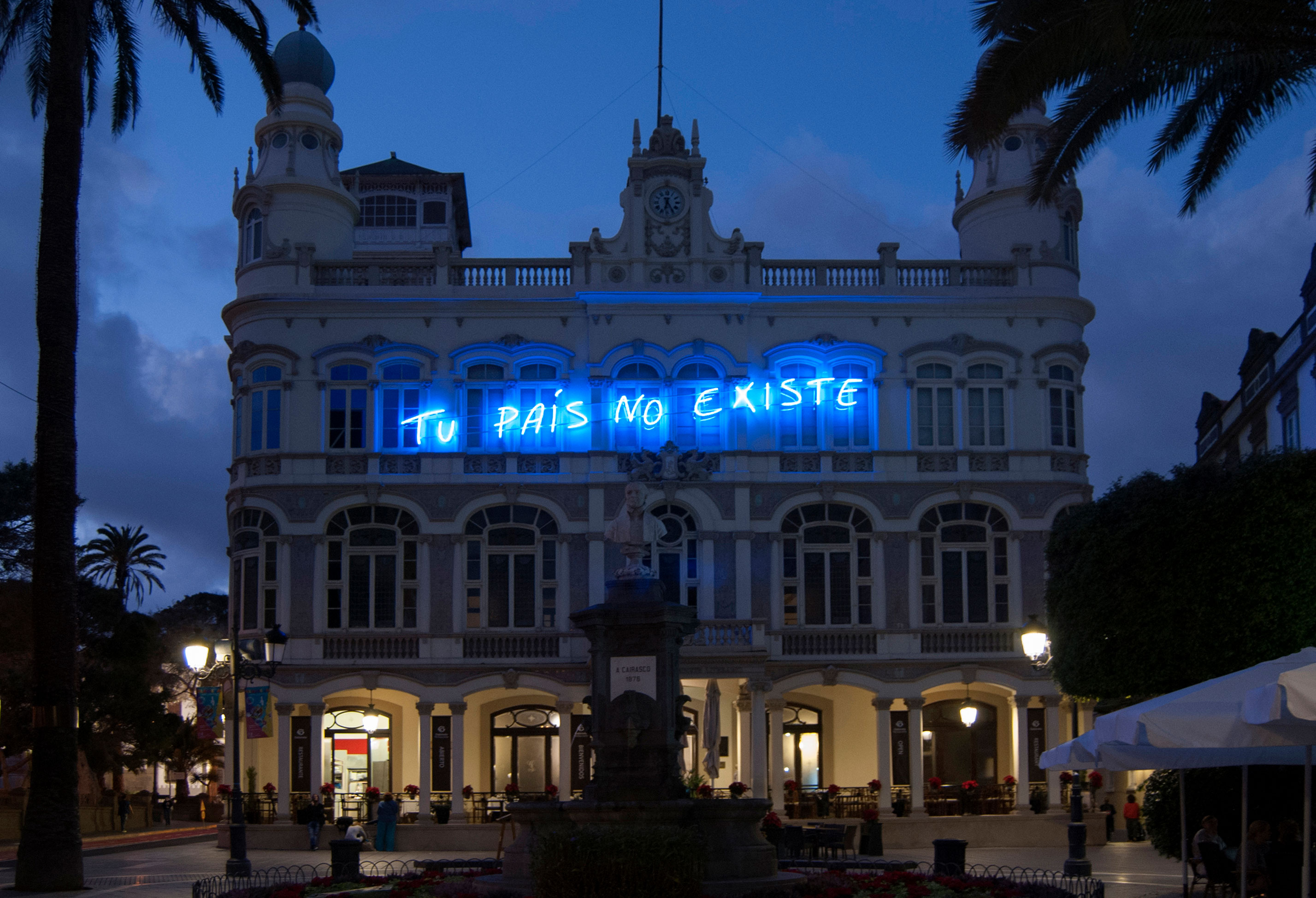
Tvoja zemlja ne postoji / Your country doesn´t exist

Tvoja zemlja ne postoji / Your country doesn´t exist - Billboards in public space

Where Everything Is Yet to Happen
1st chapter: “Can you speak of this? -Yes, I can”

Curated by Ivana Bago & Antonia Majača
@ Institute for Duration, Location and Variables (DeLVe)
www.delve.hr

Co-curators of the ‘1st chapter’ exhibition:
Anselm Franke, Vít Havránek & Zbyněk Baladrán, Ana Janevski, Erden Kosova, Nina Möntmann, Jelena Vesić

Participating artists and projects:
Ziad Antar, Yane Calovski, Libia Castro & Ólafur Ólafsson, Ivan Grubanov, Nicoline van Harskamp (in collaboration with Thijs Gadiot), Dragan Nikolić, Slaven Tolj, Liu Wei, Judi Werthein (Ivana Bago & Antonia Majača, “Can you speak of this? –Yes, I can.”)
Florian Schneider, Eyal Weizman (Anselm Franke, Circles of Collaboration)
The Archive of Self-Management (Vít Havránek & Zbyněk Baladrán)
Yael Bartana, Danilo Kiš, Artur Żmijewski, Želimir Žilnik (Ana Janevski, If You Want, We’ll Travel to the Moon Together)
A.C.A.B., Ronen Eidelman, Aydan Murtezaoğlu (Erden Kosova, Stepping Sideways)
Yael Bartana, Esra Ersen, Sharif Waked (Nina Möntmann, We Hear You Speaking in Secret Dialects)
Lutz Becker, Chto Delat/What is to be done? (Jelena Vesić, The Future Is the Extension of the Past by Other Means)

01_Tznp
Tvoja zemlja ne postoji / Your country doesn´t exist – Billboards in public space
03_Tznp
Tvoja zemlja ne postoji / Your country doesn´t exist – Billboards in public space

Libia Castro & Óafur Ólafsson, Your country doesn’t exist, 2003 – ongoing

Your country doesn’t exist is an ongoing campaign, appearing in different contexts, places, countries, and languages. So far it has appeared as a sculpture at Platform Garanti CAC; as an advertisement on national and regional TV and radio (in Iceland, the Netherlands and Austria); on billboards; as large painted wall drawings on houses and on a museum facade; in polyurethane foam and in clay; as a newspaper advertisement; as a postage stamp prototype in several museums; as a flyer; and as a drink automat serving cans of beer, soda, and water bearing the campaign’s slogan in different languages; on the cover of a magazine (a medical journal); as the coats of arms of two old sandstone  lyon sculptures guarding Museum Gouda (NL); as T-shirts and as a wall drawing in the Cafe of Rotor exhibition space in Linz etc. The work has traveled to Turkey, Iceland, Hungary, the Netherlands, Belgium, Austria and the United States – and now Bosnia and Herzegovina.

The title of the multi-faceted project Where Everything is Yet to Happen (WEIYTH) – starting off in Bosnia-Herzegovina in the framework of SpaPort Biennial 2009/10 – contains references to duration, location and variables of an expected event. These ‘uncertain parameters’ are located in a breach between a past that does not offer, in Badiou’s terms, an event to which we would bind ourselves to fidelity, and a future from which one expects precisely that – the “miracle” of event.

Although Bosnia-Herzegovina is the starting point of the project – with its perpetuating state of political ‘temporariness’ resulting from the still unresolved ethnic tensions and war traumas, the lack of consensus on the basic geopolitical ‘constitution’ and the unending protectorate of the ‘international community’ – it is by no means the only ‘place of expectation’. On the contrary, the project seeks to subvert the view of Bosnia-Herzegovina and the Balkans as the antithetical periphery of Europe, and refuses to exoticise it as a ‘space of conflict’. Rather, it establishes it as an originating point of the gaze for reflecting on the urgency to rethink the notions of future, community and co-existence beyond the dominant models of ethnopolitics and of the nation-state, both in ‘transitional’ as well as Western, ‘advanced’ neo-liberal democracies .

The 1st chapter of the project, the exhibition “Can you speak of this? -Yes, I can”, takes its cue from Agamben’s essay “On Potentiality’ and his referece to Anna Akhmatova’s introduction to her poem Requiem, in which she recounts how, while waiting in line in front of the Leningrad jail during the Stalin purges, a woman suddenly asked her if she could „describe this“. To this request to articulate the horror that surrounded them, the poet answered affirmatively. As Agamben notes, “I can” here does not mean a conviction of the possession of certain capacities that guarantee success in ‘describing’ the indescribable, but a radical acceptance of the experience of potentiality – “[which] is, nevertheless, absolutely demanding”.

By appropriating the question and its explicitly affirmative answer, the first chapter of the project WEIYTH is a way of setting up a stage for potentiality, one where „speech“, but also a refusal to speak can take place – first of all by asking the basic question of what art can, and must, speak about in complex political environments such as BH, specifically the Republic of Srpska, without taking a form of yet another ‘post/pre-emergency’ biennial.

Answering this question emerges on the basis of curatorial ‘complicity’ – by the involvement of a group of co-curators the initial starting points of the project were further articulated, accentuated or questioned, and new ones instigated, evolving into a polyphonic structure that opens up space for several points of departure for the future of the project which is itself in constant mode of becoming.

“Can you speak of this? -Yes I can” is an elaboration of some of the themes and moments which have come into being gradually through the multidirectional communication among curators and artists, that reinforced its “diagnostic” and ”analytic” capacity, forming the exhibition as an initial project thesaurus comprised of a series of topics and questions related to the issues of complicity, collaboration, politics of language, belonging, culturalization of politics, the potential of non-essentialist forms of community and finally, the audacity of speech as a form of the political.

The exhibition is accompanied by a publication with contributions by the artists, curators and co-curators.

Exhibition opening:
Banja Luka Fortress, October 20, 2009, 8 pm

Roundtable discussion with Ivana Bago & Antonia Majača, Vít Havránek, Ana Janevski, Anselm Franke and Jelena Vesić, October 20, 2009, 4 pm

Locations:
Terzić Gallery | Salon of the Museum of Contemporary art | Banja Luka Fortress | Public space

WEIYTH is a project of the Institute for Duration, Location and Variables (DeLVe), conceived and developed by Ivana Bago & Antonia Majača

Organized by:
Protok – Center for Visual Communication
Veselina Masleše 1/11, Banja Luka, BH
www.protok.org

Supported by:

Swiss Cultural Program in the Western Balkans, Robert Bosch Stiftung, Ministry of Education and Culture of RS, City of Banja Luka, Ministry of civil affairs BH